
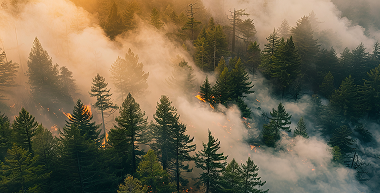
Wildfire Resilience in Canada:
Preparing for a Future on Fire
and emergency preparedness.
Canada's Wildfire Reality in Numbers
Key statistics from this article
- • Canada faces an average of 8,000 wildfires each year, burning about 2.5 million hectares of forest and causing billions in losses.
- • Just three major fires — Kelowna (2003), Slave Lake (2011), and Fort McMurray (2016) resulted in $4.9 billion in insured damages; the 2024 Jasper wildfire alone cost $880 million.
- • Average annual insured losses from catastrophic wildfires have surged from $84 million to $706 million in the last decade.
- • Wildfire smoke causes major health and economic impacts — $410 million–$1.8 billion in short-term health costs and $4.3 billion–$19 billion in long-term effects each year.
Wildfire Resilience in Canada: Preparing for a Future on Fire
Wildfires in Canada are no longer seasonal headlines; they are a constant undercurrent shaping how we live, breathe, and build. They redraw landscapes, test emergency systems, and strain communities that were never designed for this pace of change.
The numbers tell their own story. Canada now faces an average of 8,000 wildfires every year, consuming 2.5 million hectares of forest — an area roughly the size of Nova Scotia. Three events alone — Kelowna (2003), Slave Lake (2011), and Fort McMurray (2016) — generated $4.9 billion in insured losses, while the 2024 Jasper wildfire added another $880 million to that toll. According to industry data, average annual insured losses from catastrophic wildfires have climbed from $84 million a decade ago to $706 million today.
Yet the cost of rebuilding homes is only a fraction of the real price we pay. Smoke from these fires drifts across borders and seasons, darkening skies thousands of kilometres away. The Government of Canada estimates the health costs of wildfire smoke at $410 million to $1.8 billion each year for short-term effects and as much as $19 billion for long-term impacts. Behind those numbers are stories of children kept indoors for weeks, seniors struggling to breathe, and frontline workers navigating air that no longer feels safe.
This is no longer a fight against flames — it is a struggle for resilience.
Farmers on the Frontlines of a Warming Country
Few Canadians stand closer to the frontlines than farmers. Their livelihoods are rooted in the land, and when that land burns, the consequences reverberate through the entire food chain. A wildfire can erase not only a year’s yield but also generations of investment — the barns, fences, silos, and equipment that define agricultural life.
In many regions, fields double as fire corridors: dry grass and wind carry flames faster than machinery can outrun them. Equipment sparks have been known to ignite small fires that turn catastrophic within hours. And even where flames don’t reach, smoke can contaminate produce, reduce livestock productivity, and threaten water supplies.
For farmers, wildfire resilience is not a matter of insurance — it’s a matter of survival. Creating defensible space around key structures, maintaining on-site water capacity, and establishing evacuation and feed protocols for livestock are now essential practices. But as seasons grow hotter and drier, these defences must be guided by intelligence, not instinct.
That’s where new tools come in. AI-driven forecasting can flag risk days based on drought indices, wind velocity, and vegetation dryness. Drones can patrol field edges for early ignition. A dashboard can tell a farmer not only when conditions are dangerous, but which assets are most at risk. The technology exists — what’s needed is adoption and integration into everyday operations.
Agriculture feeds resilience far beyond the farm gate. Protecting farms is protecting communities.
When Fire Reaches the City Edge
If the countryside burns first, the wildland–urban interface (WUI) is where it burns last — and where the losses often hurt most. Across Canada, new housing has crept steadily into forested zones, creating beautiful but vulnerable neighbourhoods where one stray ember can become a multi-million-dollar disaster.
In these zones, fire behaves differently. It doesn’t arrive as a wall of flame but as a rain of embers, each one capable of igniting a roof, a deck, or a patch of dry mulch. The line between nature and suburbia has blurred, and so too must the line between personal and public responsibility.
Municipal leaders can’t prevent drought or lightning, but they can enforce fire-resistant building codes, update zoning bylaws to create fuel breaks, and integrate wildfire mapping into every infrastructure plan. Communities, for their part, can adopt FireSmart principles — clearing flammable debris, using non-combustible materials, and organizing neighbours to reduce shared fuel loads.
Resilience here is collective. A single fire-safe home can survive; a fire-smart community can contain.
The True Cost of Fire
The financial losses from wildfire are staggering, but they are only one dimension of a widening crisis. Air quality warnings now stretch for weeks; cities once known for clear northern skies regularly top global pollution rankings during fire season.
Public-health researchers estimate that 240 to 2,500 premature deaths each year in Canada can be linked to wildfire smoke. The cumulative economic cost of smoke exposure — including hospital visits, missed workdays, and chronic respiratory illness — runs into the tens of billions annually.
In short, wildfire is eroding quality of life in ways less visible than charred trees or lost homes. It’s in our lungs, our water, and our collective sense of security.
Technology as the Turning Point
Traditional measures — FireSmart, defensible space, better building materials — remain vital, but they’re not enough for the scale and speed of the threat. Canada needs a new generation of intelligence tools that make resilience measurable, predictive, and adaptive.
At ResilienceHQ, we’re building exactly that:
- • AI prediction models that integrate satellite imagery, climate data, and fuel conditions to forecast ignition risk days in advance.
- • Real-time monitoring from sensors, cameras, and drones to detect heat signatures and smoke earlier.
- • Resilience dashboards that give municipalities and insurers a unified picture of exposure and preparedness.
- • Automated multi-channel alerts to keep residents and responders informed the moment conditions change.
A Shared Responsibility
Wildfire resilience in Canada isn’t a single agency’s mandate. It’s a shared duty that cuts across sectors:
- • Farmers protect food security and rural economies.
- • Homeowners and communities safeguard lives and properties.
- • Municipalities plan, regulate, and enforce.
- • Insurers provide the incentives and data to prioritize prevention.
- • Technology partners build the systems that tie it all together.
Resilience is built long before the smoke appears on the horizon — in planning meetings, budget allocations, and collective will.
Looking Forward
Canada has always lived with fire. What’s changed is its scale, frequency, and consequence. With average insured losses nearing three-quarters of a billion dollars a year and health costs rising into the tens of billions, the question is no longer whether we can afford resilience — it’s whether we can afford not to build it.
At ResilienceHQ, we believe that preparing for wildfire is preparing for the future of Canada itself: a future that values foresight over reaction, data over doubt, and collaboration over complacency.
Because the best time to build resilience was yesterday. The second best time is now.
📌 Sources: Institute for Catastrophic Loss Reduction (ICLR); Government of Canada – Human Health Effects of Wildfire Smoke (2024); Insurance Business Canada (2024).